So, I am pretty much an expert on zen because I once took a yoga class and could almost hold tree pose without falling down. So yeah, I know zen. Or at least I have some things that sometimes work to calm me down slash bring me peace and happiness when I need it because let's face it, writers are not known for being the most emotionally stable of people. Everybody ready? Ommmm.
1. Actual yoga. Or exercise in general: So one of the apartments I lived in in college was literally right behind a Golds Gym (like, I might have been able to touch both if I laid flat, or at least gotten pretty close) and that was kind of the best thing ever. I am by no means an athletic or even fit person. At all. In fact I hate exercise and sweating. Just ask anyone who has ever ever made me climb a mountain (you know who you are). However. Having an air conditioned room where I could watch TV while getting my blood flowing every day did serious wonders for how I felt about myself and felt in general. However it works for you personally, exercise makes a huge difference.
2. Movies: Not much to be said about this. A good movie or TV show is the best decompression ever. We need that time to unwind and destress. Not to mention, get some creative and artistic inspiration.
3. Music: Nothing changes my mood faster than music. It can intensify happy moods and give me comfort or hope or release when I'm sad or angry. I think that's part of the glory of music. I listen to Michael Giacchino or Rachmaninoff when I write, because I can't have words, and it provides excellent background music that sort of signifies to me that it is writing time. It sort of gets me in the zone.
4. Taking walks: I need to do this more often. I always think I don't want to go outside and then I do and I come back feeling so good and refreshed. Even just sitting in a park on a sunny day can be like a spiritual experience. Maybe it's been said over and over again that we help ourselves by reconnecting with nature, but it is a truth.
5. Chocolate: Or pizza. Or banana bread or candied sweet potatoes my mom makes at Thanksgiving. Food is a very visceral experience, like a lot of these other things, and sometimes that helps reconnect us with our bodies. This one is another good reminder for me. Sometimes it is nice to eat a very slow meal and just savor every bite.
There you have it! Five things that might help bring peace and relaxation and renewal. And with that we also close out April and the A-Z Challenge. We made it! What a crazy month :)
Sarah Allen
Tuesday, April 30, 2013
Monday, April 29, 2013
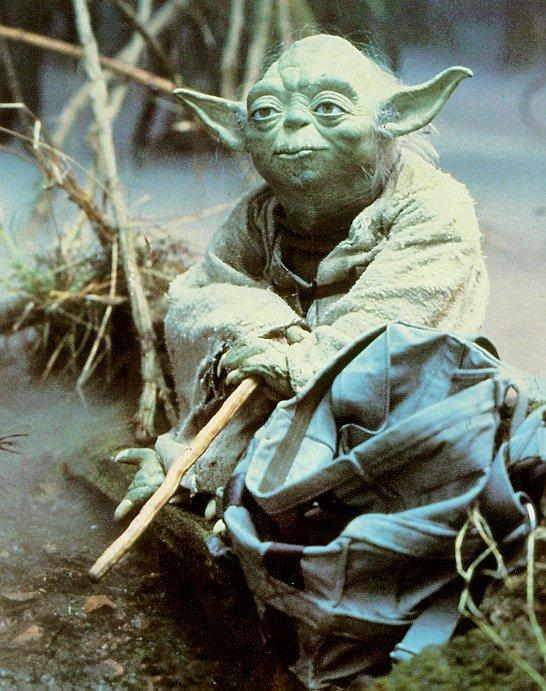
Y is for Yoda
That's right. Er...Right that is.
Some characters are so wonderful they become part of our cultural consciousness. Yoda is just such a character. So, what makes Yoda a character everybody loves?
1. Yoda is all wise: There is something appealing about characters who know what they are doing, or who are masters at whatever they do. Yoda and Obi Wan are in this group. They are leaders you can follow. If it is possible to use the force to do something, Yoda can do it. There is no question that he is the master, and you never know what will happen with those kinds of skills.
2. Yoda is subtly kick-butt: Not much explanation needed. You are someone who is not Yoda. Can Yoda whip your trash? Yes he can.
3. Yoda is quirky: Quirky he is. Think of him we do when speech patterns passive strange become. So unique and strange he is, forgotten easily he is not.
So many reasons to love Yoda. Being voiced by Frank Oz doesn't hurt either :) So, yeah, what else can you think of to love about Yoda?
Sarah Allen
Friday, April 26, 2013
W is for Waiting
That is one thing I think a person just doesn't get until they start pursuing this crazy glorious chimera called a writing career. There is so much waiting involved. So much waiting.
You just can't move forward, in many ways, without the support and say-so of someone else, or many someone else's. You are waiting to hear back from that agent or the agent is waiting back to hear from that editor. You're waiting to hear back from the cover designer or the publicist or one of the other many people involved. Even if you self-publish, you're still waiting to hear back from that book reviewer or that journalist or that critique partner or, of course, basically like everyone on the planet to BUY YOUR BOOK.
The thing is, it doesn't ever go away. At least I don't think. And that's frustrating, because as much as you try and speed up the waiting time or find things to do in the meantime sometimes you're just past the point of patience and you just want it taken care of NOW.
That's sort of where I'm at. Almost. I have been querying agents for a while now, and I just want to get my yes. I've been submitting short stories to magazines since high-school and you never stop waiting for yesses on that one. I'm just at that point where I can't really do anything more in terms of moving forward in a writing career without partnering with some industry professionals. And I want that to happen yesterday.
All this, though, brings me to the most important W word. Pretty much, to move forward in your career, you must wait. For other people. Pretty much there is just nothing you can do about it. There is one thing, though, that you never have to wait for. The most important part of your career is the thing you have complete control over, the thing that is totally up to you that you can work on and do anytime you want. Writing. The waiting will always suck, but you can always write. While one project is in the wait for everyone phase, write another one and another one. That is how we succeed.
Sarah Allen
Thursday, April 25, 2013
V is for Volume and Variety
I've heard it said in many places, and in several different ways, that the key to a successful career as a writer (or any type of artist) is two-fold: volume, and variety.
Basically this means to write lots of different things and put them lots of different places. Here are ten different ways we can try and incorporate that advice.
1. Publish novels in different venues: The options for writers are only expanding. It is no longer necessary to be in one "camp," or one side of the publishing fence. Rather, you can focus on traditional publishing while also working on self-publishing projects and submitting to small publishers. Or any combination you choose. All within contract boundaries, of course, but the point is that we can put even our big projects in lots of places.
2. Submit short pieces to magazines: There are so, so many magazines out there. Whether personal essay, short story, flash fiction, poetry, whatever--leave a little portion of your time and energy to these smaller projects and finding them homes in the many fabulous literary magazines available.
3. Submit to contests: There are contests going on all the time for books, short story collections, poetry chapbooks, individual pieces, everything. The Poets and Writers website has a fantastic list. I like the idea of continually working on those shorter pieces until you have something ready to submit to one of these awesome competitions. And then keep submitting.
4. Query articles: Even for us fiction writers, occasionally branching out into non-fiction and article writing could be a good idea. It expands our writing, our readership, and our credentials. Find something you're passionate about, an idea you want to explore, and then magazines that feature that subject. Query, and keep querying. You never know what cool experiences and networking opportunities you will find.
5. Try script: Screen and playwriting come with their own set of rules and guidelines. However, after some research and practice, they could also present some great opportunities. There are also competitions going on all the time for plays, and why not submit a movie script to Hollywood and see what happens?
6. Experiment with genre: This is where I think self-publishing could be fun. I think we all have a genre we like best, that we normally work in. But sometimes you want to try something new. If you write contemporary, try science fiction or a picture book. If you write science fiction, try historical or romance. Often your editor at a traditional publishing house won't want you going too far outside your genre, but within contractual bounds, writing something in a new genre perhaps under a new name and self-publishing could potentially get you a whole new readership. Or if you self-publish anyway, then its just a matter of expanding your circle.
7. Collaborate: I don't think there is any better way of introducing yourself to a new group of people. The group is already there, listening to someone they trust, who is now working with you. This can work for anything from books to YouTube videos. This also includes submitting pieces for consideration in anthologies. Collaboration is a great way to add volume and variety to your work.
8. Experiment in unusual venues: With shorter pieces, (and again, within contractual bounds of course) this could be fun. There are so many cool ways to do this. Make a video poem and put it on YouTube. Make a Tumblr blog or Pinterest board dedicated to your photo-poems. Produce your own mini-script and put it online. Tweet flash-fiction. Anything you can think of, why not try it out?
9. Say it out-loud: Speaking engagements have become, in a way, the modern day writer's bread and butter. This is particularly true for non-fiction. But I think any writer can only benefit from looking in to this side of things. Contact everyone: libraries, schools, book fairs, local colleges, book clubs, conferences, etc. Not every contact is going to pan out, and in fact most of them won't. But in this case I think its best to be like a dandelion, spreading your seeds as far and wide as possible until a few of them stick.
10. Write every day: This is obviously the key point. Whatever you end up doing with your writing, whatever the piece turns out to be, you can't do anything with it if you don't have it. So get those words down. Work on those big projects, the novels and screenplays, and on days when you're not feeling those, work on a short story or poetry chap book. A little bit every day goes a long, long way.
Anyway, hopefully this can get us all started on keeping volume and variety a part of our writing career. Do you think these ideas are worth the effort? What other opportunities would you add to this list?
Sarah Allen
Wednesday, April 24, 2013
U is for Unarmed
An unarmed writer does not know her target reader.
An unarmed writer has not researched agents before she submits.
An unarmed writer does not read craft books such as Stephen King's On Writing to try and improve herself.
An unarmed writer does not have a library card.
An unarmed writer does not have another project in the works.
An unarmed writer does not carry a notebook and pen with her ALWAYS.
An unarmed writer believes she doesn't have to do any marketing.
An unarmed writer thinks her writing needs no help.
An unarmed writer does not study the career paths of other writers or seek out advice from industry professionals.
An unarmed writer does not consider as many publication opportunities as are available to her.
An unarmed writer only ever reads one genre.
Such a huge arsenal of heavy artillery at our disposal. Let's just make sure we're as armed as possible.
Sarah Allen
Subscribe to:
Posts (Atom)