From Sarah, With Joy

*Poet * Author * Wanderluster*

Showing posts with label Writing Lessons. Show all posts

Monday, October 6, 2014

The Best Thing About Speculative Fiction

I think as writers we get a lot of our themes and style from our parents, or at least the way we were raised. But I have a confession to make.

My mom didn't love Harry Potter.

I know. This is one area where we differ. My mom was much more a fan of books like The Secret Life of Bees, or The Glass Castle. She prefers stuff like memoir.

Now, I don't particularly love memoir, but I love the gritty realism type of thing that she loves. As a child she gave me books like Summer of the Monkeys and A Long Way From Chicago. which I absolutely loved. Some of our favorite movies of recent years are Dan In Real Life and The Way, Way Back. Such incredible movies.

Now enter my roommates. When I went to college I got introduced to a plethora of things I probably wouldn't have been introduced to otherwise, and for which I'm very grateful. Things like Dr. Who and Firefly and Star Trek. Stuff I also absolutely, thoroughly love.

And my roommates basically all hated Dan In Real Life.

Which seemed to suggest that these genres are polar opposites, but I'm starting to see how that is false. I'm starting to see how genre is more of a venn diagram, and it's the overlapping area between these two categories that most intrigues me.

One of my favorite books that perfectly exemplifies this overlap area is The Green Mile by Stephen King. It's set on death row in the Depression era. You don't get more gritty realism then that. And the book deals in large part with hard themes like racism. But then you get this sort of mystical element--a gigantic black man with healing powers. The guards various reactions to this discovery are absolutely fascinating. The main character's faith in general is tested, then strengthened, and he has to make some tough and hard choices about what to do. He does his best, and is open to learning and change through his relationship with this man. Another guard is so manipulative, prissy, and crazy that he can't remotely be trusted with the secret.

In other words, this story enables us to explore humanity, at its best, worst, and most complex, in ways we could not have without that little bit of magic. Speculative fiction enables us to explore what it is to be human by testing us in superhuman scenarios.


One of my favorite episodes of Star Trek is in the first few seasons of TNG. Data is put on trial to determine if an android has the freedom to refuse tests, or make their own choices. In other words, if he is to be granted the same rights as his human (well, organic might be a more appropriate term) shipmates. Picard is charged with defending Data, and his final statements give me shivers just thinking about it. The entire episode is about how it is our treatment of subordinates and those less powerful or different that says the most about who we are as humans.

And they couldn't have framed that as dramatically and starkly as they did without an android in the defendants seat.

It is often said that one can explain a thing best by explaining what it is not, and perhaps speculative fiction is what gives us the opportunity to do that with humanity. It's a hobbit's stubbornness, a dwarf's sense of pride, these familiar characteristics that resonate with us, and frame this human qualities in fresh, interesting, and memorable ways.

Of course all genres have value, and serve their own legitimate purpose. But for myself as a writer, it's this overlap area that really intrigues me. I very rarely write hard core sci-fi or fantasy, but I also have a hard time writing anything without some element of the weird and supernatural.

What about you? What is your favorite part about speculate fiction, or the genre that you write?

Write on!

Sarah Allen

This Week on Social Media:

For more frequent updates, writing tips, and funnies, follow on FacebookTwitterGoogle+
YouTubePinterestTumblrGoodReads, and/or Instagram.

SUBMISSION OPPORTUNITIES:
  • Writers Digest: Your Story 61Write the opening sentence (just one, of 25 words or fewer) to a story based on a photo given. You can be funny, poignant, witty, etc.; it is, after all, your story. Due Oct. 13.
  • Black Balloon PublishingA prize of $5,000 and publication by Black Balloon Publishing will be given annually for a short story collection or a novel. The editors will judge. Submit an unpublished manuscript of at least 50,000 words during the month of October. There is no entry fee. Due Oct. 31.
  • Drafthorse Online Publicationdrafthorse is a biannual online publication of fiction, creative nonfiction, poetry, visual narrative, and other media art where work, occupation, labor—or lack of the same—is in some way intrinsic to a narrative’s potential for epiphany. Due Oct. 31.
  • Tavern Books Wrolstad Contemporary Poetry Series: Tavern Books seeks submissions of new, full-length poetry manuscripts for the Wrolstad Contemporary Poetry Series. Open to all female poets 40 years of age and younger who are US citizens, regardless of publication history. Selected author receives a $1,000 book sales advance, paperback and hardcover publication in the Tavern Books catalog, national distribution, and a close working relationship with the editorial staff. Due Jan. 15.

SPOTLIGHTS:

Monday, September 22, 2014

4 Great Lessons for Writers from Ron Swanson

So my roommate and I just finished catching up on Parks and Rec.


I didn't expect to ever find a show with quite that perfect mixture of sweet and awkward and real and poignant that The Office had, but let me tell you, Parks and Rec came pretty darn close.

As with The Office, this show is all about character. We care about these shows not for the ridiculous and quirky plots, but because the characters are so absolutely engaging. Each character seems to be perfectly balanced between very grounded and recognizable as well as over-the-top quirky and interesting. If we can write characters the way Michael Scott and Leslie Knope were written, we're on a good road.

Perhaps my favorite character (well, one of them...there's just so many good options!) was of course, the oft quoted Ron Swanson. Quick bit of trivia for those who watch the show: did you know that Nick Offerman, who plays Swanson, is actually a carpenter, actually plays the saxaphone, and is actually married in real life to the actress who plays Tammy Two? That just brings me so much weird joy I can hardly stand it.

Anyway. With characters like Ron, we writers could do well to take lessons from both the character and the way he was written. So here are a few lessons I think writers can learn from Ron Swanson:


1. We love all-in characters: I think in any storytelling medium, we love over-the-top obsessed characters. Characters who are so into something we start being reminded of that character whenever we encounter their obsession in real life. Parks and Rec has many examples of this type of character quirk. For example, at our post-church "munch-and-mingle" yesterday we had strawberry shortcake with whipped cream and as I lathered on that yummy whipped cream I couldn't help but think of Leslie Knope. As for Ron Swanson, I think of him whenever I have a burger or a steak. Any big hunk of meat on my plate is a good Swanson moment for me. I smile to myself as I remember the utterly devastated look on his face when he sees that his favorite steak place has been boarded up. I really think it just comes down to loving characters who are absolutely passionate, and when its so specific and visceral, that's something that is very easy to connect with.


2. Your readers will have possibly surprising interests: The Ron Swanson we initially get to know is a burly, mustachioed, meat-loving, wood-carving lug of a man. His interest in meat and woodcarving seems to hit the nail right on the head. Of course someone like him would love meat and chopping down trees. Of course he could finish off an entire office building floor by himself in less time than it would take the entire reconstruction crew.

But then we are introduced to something surprising--Duke Silver, Swanson's swoon-causing saxophone playing alter-ego. This is a more covert but still solid part of Ron's identity. It will be the same with our readers. Writers are often told to focus on the clear interests of your ideal reader, and that is great advice. Approaching Ron Swanson via his interest in meat or carpentry is a good plan. But we might do well to keep in mind that the other, perhaps less obvious interests we may have, may be shared by people who would fit well in our readership. We can use these interests as social media and blog topics, or article ideas, or in a myriad of other ways.


3. Not all your readers will be on the grid: Anybody remember the episode when Ron finds out that advertising companies have some of his information, and he chucks his whole computer in the dumpster? Now that's an extreme example, but there are plenty of people who are best approached somewhere other than cyberspace. Perhaps there is a reader out there ideal for your particular book who gets most of her recommendations and info from friends or newspapers or magazines. We don't often think of those venues in our instant-info-internet era, but they are still very much there, and very valuable. This is why I think it wise for any writer, regardless the genre of your books, to pitch articles to various magazines and submit short stories and poetry to magazines and anthologies. There is still something very powerful about the printed page, and these venues provide a way to reach readers we may not have otherwise. 


4. We love the soft side: One reason I love Ron Swanson so much is that my favorite characters are the ones with a gruff exterior who very rarely reveal their softer side. It just makes me squee with delight, and I'm pretty sure I'm not the only one. Our hearts are warmed when Ron hints in the best way he knows how the way he truly feels about Leslie. We love when Ron gets embarrassed or even slightly emotional. These show the human side of these types of characters and take them past entertaining into relatable.


I hope this gives you some good ideas and inspiration. What do you think? Can you think of any other lessons we writers can take from the Swanson?

Write on!

Sarah Allen

This Week on Social Media:

For more frequent updates, writing tips, and funnies, follow on FacebookTwitterGoogle+
YouTubePinterestTumblrGoodReads, and/or Instagram.

SUBMISSION OPPORTUNITIES:

  • Blue Mountain Arts: Blue Mountain Arts is interested in reviewing writings that would be appropriate for publication on our greeting cards. We are looking for highly original and creative submissions on love, friendship, family, philosophies, and any other topic that one person might want to share with another. Please note that we do not accept rhyming poetry. Ongoing.
  • The Rain, Party, & Disaster Society: The Rain, Part, & Disaster society anthology is seeking poetry, non-fiction essays, and flash fiction that tackles their October theme: The End. Send your work that thematically, literally, or figuratively includes concepts of endings or the end of something. Due Oct. 15.
  • Coe Review: The Coe Review is a magazine that unleashes refreshing perspectives and unheard voices. We accept all forms of poetry for our fall issue, and, from our hundreds of submissions, we choose those with original forms, styles, messages, and origins. Due Oct. 25.
  • Dark MatterDark Matter publishes literary speculative poetry, flash fiction, short fiction, essays, and musings. We are interested in all things speculative in literature. We are not interested in anything dogmatic or mystical. Use natural metaphor to explore meaning and challenge traditional wisdom. Due Dec. 1
SPOTLIGHTS:

Monday, August 18, 2014

4 Ways Writers Can Go "Back To School"

This time of year always gets me thinking about that wonderful line from You've Got Mail when they're talking about school supplies and "bouquets of sharpened pencils." It's been a few years since I've been a registered student, but I do get nostalgic for some of those school days. School is awesome.

Even if we're not technically students at an official school, this time of year can inspire us to further our education. I personally feel like the only "hopeless" person is the person who feels they have nothing left to learn. We are always learning, always improving. So without official school, what can we writers do to keep finding teachers, and keep learning?

1. Read great writing books. There are so many options out there. Just head to the Writing and Publishing section of your local Barnes and Noble, and you'll see. A classic, and my personal favorite, is Stephen King's On Writing. Plot and Structure by James Scott Bell was also incredibly helpful.

2. Listen to TED Talks. These really are one of the best ways to casually continue one's education. There are thousands of TED talks uploaded, each one inspiration and informative, even (especially) ones that seemingly have nothing to do with writing. They are fun to listen to while at work or in the car. Here are a couple of my favorites:


3. Watch educational videos on YouTube. In the same vein as TED Talks, YouTube provides an endless conglomeration of incredible educational videos on basically any topic. Whether you are doing research on a particular topic for a novel or looking to broaden your education in general, YouTube is a great place to start. My favorite channels for this are CrashCourse by the indefatigable John and Hank Green, and VSauce.

4. Add more blogs to your subscription. Whatever blog subscription you use, find a couple more blogs that do great posts and add them to your feed. That way you are constantly learning from active participants in your field. See the spotlight section below and in other posts for some recommendations.

That's all for today, but I'm excited to see what ideas you guys have. What resources have helped you continue your writerly education?

Write on!

This Week on Social Media:

For more frequent updates, writing tips, and funnies, follow on FacebookTwitterGoogle+
YouTubePinterestTumblrGoodReads, and/or Instagram.

SUBMISSION OPPORTUNITIES:

  • Chattahoochee ReviewThe Chattahoochee Review seeks submissions for its Fall/Winter 2014 double issue with a special focus on “Skin.” Literal and figurative explorations of the theme welcome. Due Sep. 1
  • The Conium ReviewThe Conium Review Online Compendium seeks flash fiction. Work must be unpublished. Simultaneous submissions are allowed. No reading fee. Due Oct. 1
  • The Minetta ReviewThe Minetta Review is a literary and arts publication managed by undergraduate students at New York University. If you are a poet, proser, prose-poet, painter, sculptor, photographer, digital illustrator—otherwise an experimenter of combining word and visual art—the Minetta Review staff encourages you to submit your work. Due Nov. 15
  • Writers Digest-Your Story 61: Write the opening sentence (just one, of 25 words or fewer) to a story based on the photo to the left. You can be funny, poignant, witty, etc.; it is, after all, your story. Due Oct. 13
SPOTLIGHTS:

Monday, July 28, 2014

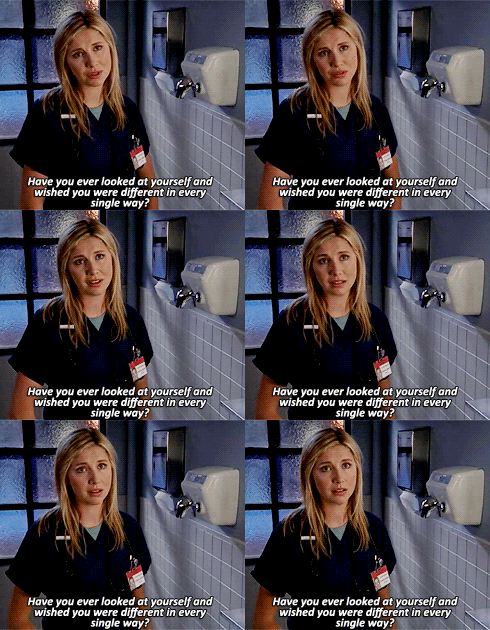
6 Things Writers Can Learn From Scrubs

I recently finished going through the series Scrubs.

Guys, I'm a little in love.

With all of them. Seriously, the writers and actors on this show knew exactly what they were doing. The deftness with which they moved from gut-busting laughter to tear-jerking poignancy was mind-blowing. And they did it every episode. So what lessons can we writers take from this hilarious and well-done show?

1. Sarcasm + Vulnerability = AWESOME. Dr. Perry Cox was my first love of the show. I have serious thing for grumpy, sarcastic, hilarious old men who you just know have a mushy, kicked puppy center. In other words, Dr. Cox was basically tailor made for me. Somehow characters who are for the most part hardened and witty and then stumble into these desperately vulnerable moments make both the wit and the vulnerability that much more piercing. It is really this character (and the genius that is John C. McGinley) that can take the show from this

to this


and back again faster than you can say Percival Ulysses Cox.

2. Running gags make the audience feel included. I don't know about you guys, but this show made me want to Eagle and drink appletinis and start giving people titled high fives. Because I could laugh along at the inside jokes, I felt included. These guys were my friends. And I think this can work in books too, including stand alone novels. When you know the characters' inside jokes, you start feeling like you know them intimately.

3. Let your losers win one every once in a while. Often we have characters that spend the majority of the story being downtrodden. Often its humorous, like with Eeyore, and my maybe other favorite character in Scrubs, Ted Buckland. Yes, I admit, it's funny to see him be Bob Kelso's whipping boy, but seeing him get a win is extremely satisfying. And kinda freaking adorable.


4. Know what drinks your character likes. Saying that JD drinks appletinis is basically a shorthand. We get a glimpse of who he is just by that detail alone. It's all those little details and quirks that make us as an audience feel like we really know the character. It's like how, if you notice, 93% of the time the camera pans to Ted, he's doing this:
That constant hair-pulling, that little appletini, almost tells us more about these guys than entire paragraphs could do.

5. There's just something about buddies. We love watching their antics, and rooting for them as they conquer the world together. Watching a buddy pair that you just know will never, ever be separated...there's just something so comforting and so bolstering about that. And there's just no buddy pair...okay we'll say it, guy love, quite like Turk and JD.


6. Feminine strength comes in different forms. There was no shortage of strong women on this show. I mean, in their own way, every woman was strong. Carla was strongly grounded in her identity. Jordan was strong in her sharp and wacky ferocity. And even Elliot was strong in owning up to her own neurosis and not letting any of them stop her for long. So just remember that "strong woman" is not a character type, because every strong woman is strong in their own unique way. When you recognize that, it might even help you dig deep into your female leads to see what special thing about them actually provides them their strength.


I hope that helps, even if you aren't super familiar with the show. For those of you who are, are there any other lessons for writers that you might take from it?

Write on!

This Week on Social Media:


For more frequent updates, writing tips, and funnies, follow on FacebookTwitterGoogle+,YouTubePinterestTumblrGoodReads, and/or Instagram.

OPPORTUNITIES:

  • North Dakota Quarterly: "North Dakota Quarterly, an interdisciplinary, peer-reviewed journal, seeks contributions for a special issue on the theme of “Slow.” We invite nonfiction essays, short fiction pieces, poems, and artistic images that address or are inspired by this concept of “slow.”..." Due Oct. 1.
  • The Drunken Odyssey: "The Drunken Odyssey, an amazing writing podcast, needs personal essays for its “Book that Changed my Life” segments. Send pitches for essay ideas to thedrunkenodyssey@gmail.com. For approved pitches, essays should be between 500 and 800 words..."
  • Snake Nation Press: "A prize of $1,000 and publication by Snake Nation Press is given annually for a poetry collection. Submit a manuscript of 75 to 100 pages with a $25 entry fee by August 31. E-mail or visit the website for complete guidelines..." Due Aug. 31.

SPOTLIGHTS:


Monday, July 21, 2014

Writing Lessons from the Las Vegas Pinball Hall of Fame

Vegas has some really cool things. One of them is the Pinball Hall of Fame a couple miles east of The Strip. Some friends and I recently took a trip there and so I decided to make a thing of it.

I used my trip to the Pinball Museum as a chance for another writing tutorial video. If any of you are the type who like YouTube videos on writing, I hope these are useful to you.

Enjoy!


I also want to point out the new newsletter sign-up on the right hand sidebar. This is more a casual random updates thing. By random I mean no more than once a month, and by updates I mean mostly writing tips and resources from around the interwebz and funny awesome things. You also get a free copy of 50 Marketing and Networking Tips for Writers. So if you're interested and pop in your email I won't abuse it. Unless you count pictures of cats and Benedict Cumberbatch as abuse. Just kidding. Sort of. 

Anyway.

Write on!

Sarah Allen

Monday, May 19, 2014

What I learned from watching Leverage

I recently finished going through all five seasons of the show Leverage. And guys, I had such a fun time.

The word 'delightful' can't be used to describe a lot of the shows today, but it works here. Leverage is just so much fun. Leverage is about a team of "thieves" who come to the aid of those being taken advantage of who are not in a position to help themselves. Basically, they steal back what has been stolen, in a bit of a Robin Hood type role.

Here's the thing about this show. There is one thing they did incredibly well, and one thing they didn't do so well.

What they did absolutely wonderfully is character. Each character is wonderfully developed, and all the actors do such a great job bringing the characters to life. They are well enough developed that when things happen you know exactly how each character is going to react and then they do and its hilarious. Their interactions are very well crafted, and a blast to watch.

The issue with Leverage is the occasionally unbelievable plots. Often things happen that do not seem realistic even within the realm of the wacky show. Or the stories work out in ways that keep you from suspending your disbelief.

The thing is, even when the plots seem unbelievable, the characters are so delightful and fun to watch that it almost doesn't matter. People enjoyed the show just based on the characters. However, I think the show would have been more successful if the plots had been dealt with more gracefully.

Lesson to be learned? People will stick around for well-crafted characters. Putting that character in a believable story is the magic formula.

Write on!

Sarah Allen

Wednesday, April 2, 2014

B is for Benedict (Yes. Cumberbatch.)


I know, I know, I talked about Colin Firth yesterday and I'm dedicating a whole post to the one and only Benedict Cumberbatch today, but now I just have to find a way to work in Meryl Streep and my fangirling will be over. (Ha. Ha ha.)

But don't worry, this is going to be more than just a gushy post. I could go on and on (and on) about Benedict's cheekbones alone, but our friend Benny is much more than just a pretty face. He has a freakish amount of talent and has made some smart decisions in his career that I think we writers can learn from.

So here we go.

Five Things Writers Can Learn from Benedict Cumberbatch

1. Do good work by playing to your strengths. Benedicts sharp features and low, rumbly voice are not just ridiculously swoonworthy, they have enabled him to fit well into roles like Sherlock Holmes and Smaug the dragon. If you watch Benedict, he has two sides that can almost be split into dark versus vulnerable, (Occasionally even goofy. Photobombing U2 at the Oscars, anyone?) He's tapped into that unique combination, sometimes emphasizing the dark (Kahn) and sometimes more vulnerable (Hawking). He knows what he can do, and does it brilliantly.

2. Be pleasant to work with. Every interview I've seen when people talk about working with Benedict Cumberbatch, the person always mentions how nice he is, and how easy he is to work with. It's pretty much as simple as that. If you're nice to work with, people will want to work with you. And that way, you can...

3. Work with fantastic people. Martin Freeman's face in that graveyard scene in the season 2 finale of Sherlock...I can't even. Martin Freeman absolutely keeps up with Benedict in that series, and I personally even see the power balance shifting in Martin's direction in season 3. And the creator/writer of the series, Steven Moffat, is also a genius, and has given Martin and Benedict absolutely genius writing to work with. To make that show as successful as its been, Benedict needed to not only be brilliant, which he was, but also work with brilliant people, which he did. There's success enough for all of us, and helping each other is the best way we have of getting there.

4. Vary your work. This is one of the more specifically strategic things I've noticed Benedict doing lately, and I don't know if it's a conscious decision or if he's just naturally making smart choices. The two movies he did in the past year were The Hobbit and 12 Years a Slave, and I don't think you get more varied than that. By taking on such a wide variety of roles he has been able to be in commercial blockbuster movies like Star Trek as well as play with the Oscars crowd. I think that's a lesson we can all learn from.

5. Be sharable and niche. I know that sounds like two things, but let me explain what I mean. The internet subculture absolutely adores Benedict Cumberbatch. If I'm not mistaken he was the most shared person on Tumblr last year. This happened because Benedict Cumberbatch was both niche, and sharable. He was niche because of his roles in Sherlock and Star Trek, franchises the people of the interwebz have adored for a long time. They fit the internet's niche. (The interesting thing is that he was so strongly niche he's now starting to explode into a mega star in blockbuster and Oscar nominated movies.) He is also immensely, ridiculously sharable. Do I need to explain why?

And we don't need knife-sharp cheekbones and luminescent eyes to be niche and sharable, either. All we need to do is tell our own, unique types of stories, stick true to them, and then find visual and sharable ways to reach out to the internet community in our marketing. That's something we can all do, regardless of facial features.

There you have it. Five things we writers can learn from Benedict Cumberbatch. Anything else I should add to this list?

Sarah Allen

P.S. Welcome to all the new A to Z visitors! I invite you to subscribe to this here bloggy blog or connect on Facebook or Twitter or any of the other places via the big red buttons on the left side and make sure to leave me links to your profiles so we can stay cyber friends even when April is over, and forever! (And have Benedict's chrystaline eyes staring in to your soul for ever and ever and ever...)

Thursday, February 27, 2014

Writing Lessons from SyFy's Face Off

One of my favorite reality shows--perhaps my very favorite--is Face Off on the SyFy channel. I wish it was more well-known because it is dang cool. In this show they make characters and creatures based on some quite awesome challenges, and it is incredible to see what they come up with. Not only do I find the show creatively inspiring, I definitely think there are some great lessons to be learned from it. Here are a few.

1. Concept First: One of the first things I noticed about the judging process and results is that the judges almost always favor concept over execution. In other words, if two people are on the chopping block and one of them had a cool concept but kinda botched the execution and the other person did an okay job with the making of their makeup but the concept was a fail, they always keep the one with the cool concept. I think this is because you can work with one, but not so much the other. If your story is good, you can work and get help making the writing smooth and pretty. But if you're story is blech, no amount of beautiful writing writing can save it. (Unless your name is Francis Scott Fitzgerald.) 

2. Community Rocks: My roommate often comments on how refreshing it is to watch a reality TV show in which all the contestants are friends and support and help each other. When one person is not going to be able to finish their mold before the day is out a couple other people come and help them. I've seen them take reference photos of each others tongues and ribs. In what other reality show do the people actually help each other? And I think there's a lot to be learned from that. Each book and story is so different that we really aren't in competition with each other, and how many of us read only one type of novel or buy only one book a year anyway? There's room for all of us on plenty of peoples shelves, and we'll all get there faster and happier when we help each other.

3. Critique Helps: Something you notice in most reality shows is that its listening to the mentors and judges feedback is 99% of the time the right decision. In Face Off they have a mentor walk through and give helpful advice and feedback on everybody's works in progress, and almost always the people who don't listen to the advice end up suffering for it. Those who listen still stay true to their vision, but external feedback from wise eyes actually helps them realize that vision more successfully. I like to think of Neil Gaiman's wise words about reader feedback: "Remember: when people tell you something’s wrong or doesn’t work for them, they are almost always right. When they tell you exactly what they think is wrong and how to fix it, they are almost always wrong."

Anybody else watch Face Off? 

Write on!

Sarah Allen

Wednesday, November 13, 2013

Author Marketing Lessons from Grumpy Cat

There always seems to be something new that's gone "viral," that everyone's seeing across multiple social media platforms. Even those not online much seem to hear about certain things almost through cultural osmosis. When we're marketing and trying to spread the word about our books, what better thing could happen?

There's no key or formula for "going viral." A video or blog post that someone works weeks on will languor in relative obscurity while the thing they whipped up in one day will get all the crazy buzz. So yes, it's hard, almost impossible to gauge. However there are certain things that help, certain lessons to learn. Today I thought it would be fun to look at some of the lessons learned from one of those viral sensations, Grumpy Cat.

Be Consistent. Everybody knows what to expect with Grumpy Cat, even when the hilarious and awesome owners are taking pictures of Grumpy at Disneyland. Because its so pervasive, when anybody wants to express frustration and just plain grumpiness, Grumpy Cat is one of the first things they turn to.

Now, I'm probably going to have some trouble with this, because I hope to write in multiple genres. However, I am going to try and be consistent wherever I can: in terms of voice, style, etc. You can also be consistent across your various social media platforms. Even consistent scheduling can help. I follow many, many blogs that I read regularly, but for example, I actively wait for and seek out blog posts on Anne R. Allen's blog because I know there will be a fabulous and helpful post waiting for me every Sunday. I know that every Tuesday and Friday I'm going to get a YouTube video from John and Hank Green.

Be Genuine. Grumpy Cat is huge because everyone can immediately understand and sympathize with that fabulous expression. We know exactly what that face means, and have felt it ourselves. People like it when you get real, past the fluffy niceties and superficial pleasantries. We're not Victorian England anymore. We know we're all imperfect and often hilariously fallible and human and we as a culture would most often rather talk about it than gloss over things and pretend there are no issues. In fact, its this sense of humor that is often exactly what's needed to help deal with the issues and problems, even if its just on an emotional level. So be real. We're all here to connect with each other.

Be Shareable. Part of the reason Grumpy Cat succeeds is because its so simple and easy and convenient to spread it. You can quickly find and post a Grumpy Cat picture on Facebook or Twitter or a Blog or Pinterest or anything. People can easily "read" the image, have a good laugh, and quickly move on. That's what the internet is about these days, and though things like long and in depth are still wonderful things in their own right, they're not as easily shareable. People like bullet points and numbered lists and humor and, especially, images. If it takes more than point and click to spread your news, more often than not, people are going to move on rather than expend the effort.

Hopefully these principles can be applied to all types of book marketing. What other marketing lessons do you think we could take from Grumpy Cat?

Sarah Allen

Monday, November 11, 2013

My Top Three Most Memorable Villains

I've talked before about how difficult it is for me to write villains. Every time I try, or even try brainstorming and outlining my "antagonist" character, they always end up Snape-like. As in, more anti-hero than true villain. I want my villains to have a tragic back-story and maybe even a last-second moment of redemption, which just makes me sympathize with them and often find them more interesting than my hero. This has even come up a couple times in college creative writing classes, where I was often told that my characters are too nice and my villains not really villainous.

Today, though, I want to take a look back at the three most successful, effective and memorable villains, at least in my opinion. These are the characters I want to personally keep in mind when I do, in the future, try to write truly despicable characters, or at least more really evil antagonists. So without further ado, here they are. My top three favorite and most memorable villains.


1. Benjamin Linus: Yep, we're back to Ben Linus. You know me, I have to bring him up every once in a while or I start doubting myself. I've said it before and I'll say it again, Benjamin Linus is one of the most well-written and intriguing characters on television, and while the writing itself was quite brilliant, a lot of the credit goes to the paralyzingly genius Michael Emerson. You fellow Losties know what I mean. "So yes, I lied. That's what I do." You heard that in his voice, didn't you? For me, Ben Linus is in that same Incredibly Sympathetic and Heartbreaking category as Snape, but I'm adding him on this list because I know plenty of people who find him truly and thoroughly villainous. And while I think on Lost there were more true "villains" than him, none of them held a candle to the complexity and awesomeness that was Ben...er, Doctor Benjamin Linus.


2. Moriarty: How amazing is this character? I mean, the character of Sherlock Holmes needed a villain that could match him, and he got that in Moriarty. The version I'm really thinking of is, of course, the aching and slightly mad version played by the incredible Andrew Scott. I love me some quirk, and Scott's Moriarty has that in insane spades. Sherlock: "People have died." Moriarty: "That's what people DO!" Again, it's that genius voice and line delivery. Maybe it's the voice that truly makes the villain. It gets stuck in your head. "I'm *so* changeable!"


3. Wild Bill Wharton: Ok. When I think of truly despicable, awful, truly evil and completely unsympathetically villainous characters, this is the face that comes to my mind. (Either him or Bob Ewell from To Kill a Mockingbird.) In the book he is just as completely evil, but really I think, again, some of the credit is due to the chillingly fabulous and insanely underrated Sam Rockwell. (You've all seen The Way, Way Back, right? Right??) Seriously. Amazing. Pair that genius acting with a character by Stephen King and you've got a match made in...well, Hell. Percy Whetmore, also from The Green Mile, could also deserve a place on a truly despicable villains list like this. Thank you, Stephen King.

These are the first characters that come to my mind when I think genius villain. Mad villain props also have to be given to Dolores Umbridge, more despicable even than Voldemort in my opinion, Darth Vader, and of course, Heath Ledger's Joker. So yeah, I don't do well at villains, but as I try and teach myself, these are the evil masterminds I will try to learn from.

Who are your favorite/most successful/most memorable villains?

Sarah Allen

Monday, November 4, 2013

NaNoWriMo Lessons for Non-NaNoWriMoers

So, I know there are a lot of people doing NaNoWriMo. Lots. But there are also a lot who are not doing it, myself included. Everyone makes their own decisions about doing or not doing it, obviously, personally I just don't feel like I can keep up the pace and want to work on increasing my pace yearlong. However there are very good reasons to participate in NaNoWriMo, and a lot of lessons to take from it, whether you participate or not.

1. Just write. This is the main point of NaNoWriMo, obviously. A person cannot be a writer if they don't write. We have so many editorial voices going on in our heads, so many things taking our time in our day-to-day-lives. In other words, the excuses are ad infinitum. NaNo really makes a point of just getting it done. Just buckle down, sit down, and crank out the words no matter if half of them amount to nothing but horse poop. The cleaning and editing can come later. But you can't edit a blank page.

2. Community is valuable. One of the coolest things about NaNo in my opinion is the sense of community. The participants gather together, psych each other up, inspire each other and assist each other. The NaNo blog has respected and intelligent writers who guest post fantastic and wonderful advice that can be applied way beyond the month of November. I think this sense of community is valuable, and something every writer should participate in and be grateful for all year long. This is one reason I love blogs and Facebook and Twitter and YouTube and Pinterest. They are some of the best places to meet like-minded folk and be inspired.

3. Goals are helpful. Even for those of us not writing the 1,600 or so words per day as part of NaNoWriMo, the concept of setting a daily word count is a very old but very wise and practical piece of advice. That's one of the first things we hear as writers, is to get down a certain number of words a day, but its good to be reminded. And it's this kind of simple goal-making that accomplishes big things.

Are you participating in NaNoWriMo this year? 

Sarah Allen

Monday, August 26, 2013

Read Like a Teacher

One of the most ubiquitous pieces of writing advice we get is to read, read, read. It makes sense, right? We need to expose ourselves to what's out there, learn from the masters of the medium we want to work in. In fact, we are often told to "Read like a writer." That sounds all well and good, but if you're like me than you wonder what that means exactly. How does one read like a writer?

Well, as I've been preparing for the beginning of the school year, I've come up with somewhat of an answer to that question. I believe that to read like a writer, the best way is to read a piece of literature as if you were going to teach it.

Imagine that you were going to teach the book you're reading right now. When I think of it that way, as I have been the last couple weeks, it makes subtle changes to what I notice and pay attention to as I read. I'm focusing on plot arc and sentence construction and character development and theme. Things I can discuss with my class. Tools of our writers trade and areas in which we need to be continually improving. It's like being a watchmaker and paying attention to the mechanics of your watch rather than just what time it's telling you.

Reading like a teacher can inform your reading selection as well. I've kind of found three areas where I'm expanding my reading as I prepare to teach. First, I'm doing a lot more research type reading, online and otherwise. Secondly, the Norton Anthologies I used in college have become a bedside staple. Reading and studying (again) all these poems and stories from centuries ago has been so cool. I think its important for writers to explore and familiarize themselves with the beginnings of our language.

I'm also going back and reading classics I read in high school. I had a really unique and spectacular high school experience where we read a huge number of incredible books and I just devoured all of them. It is in large part thanks to my high school English teacher that I want to write. Anyway, since then, though I loved all the books we read and still have them on my shelves, I've mostly subscribed to the Stephen King philosophy of reading, meaning life is too short too reread. But now, partly because I want to see if I could teach any of these books, and partly just because its time, I'm starting to go through some of them again. Right now I'm on Their Eyes Were Watching God.

So anyway. All this is not to discount the pure joy of simply getting lost in a book, and there is definitely value in that as well. But when you want to read a book as a writer, as someone looking for technique and wordsmithing tools, it might help you to read like a teacher.

What book would you personally want to read like a teacher, for analysis and technique?

Sarah Allen

Monday, August 12, 2013

6 Things I Learned Working at Barnes and Noble

Whew. Okay. So I'm in the beginning stages of getting settled in Vegas. I start teacher training today, and I'm terrified and excited.

One thing I left when I left D.C. was a job at Barnes and Noble, and the incredible, hilarious and kind people I worked with there. I learned a ton while working there, and I thought I'd share some of those things that might be useful and applicable to us as we work towards furthering our writing careers.

1. Who goes to brick and mortar stores: The trends I noticed at the store were very interesting. I definitely noticed that three groups of people tended to visit the store more than any other. I almost always worked in the morning and early afternoon, so evening trends may be a little different. But the group I noticed most often were mothers with young children. This may have had more to do with our Lego and train table than anything else, but there you have it. I also noticed quite a few older people. I think the older generations are still simply more comfortable with paper books over electronic devices, and I don't necessarily think they're wrong. The other group I noticed were career professionals: nurses, artists, or businessmen looking for applicable books.

2. Two different types of promotion: There are basically two different types of promotions that Barnes and Noble stores do. The first is top down, nation-wide promotions of bestsellers, holiday promotions, stuff like that. The second type is set by the individual store and determined by local store management. Basically this means that it is possible to work with local management to get your books put in better spots, if the local management likes you and your book. Sometimes. Possible. It's worth looking in to, for sure.

3. You want booksellers to like you: This is a duh point, but I didn't quite realize how important this was until I was a bookseller myself. There are a few times when the booksellers are making decisions: picking this book or this book to send back, organizing shelves and picking which books to face out, answering customers requests for recommendations. All this means that if a bookseller likes you, or is even familiar with you a little, it is to your advantage. So whenever you go places find the local bookstore, drop in and say hi and offer to sign a few copies of your book. It was always fun when that happened, and besides, autographed copies can't be sent back to the publisher.

4. People shop differently for fiction versus non-fiction: What I found, and this is obviously a generality and not a hard and fast rule, is that people looking for non-fiction tend to have a specific book or author in mind. If not that, then at least a very specific topic. On the other hand, while people definitely were looking for specific novels, there were a lot more browsers in the fiction section, people just looking for books to jump into their hands. This is useful in terms of marketing, although I think taking aspects from both types of shopper is the best idea.

5. Media attention works: There is not much to say about this, accept that almost every day I had someone (usually an older person) come up to me with a folded newspaper, point to a review and say, "Where can I find this book?" So basically, take advantage of whatever media opportunities you can find, national, local and everything in between.

6. Books as gifts: Something I noticed that I didn't necessarily expect was this: People seem much more comfortable and willing to buy books as gifts for friends and family than they do buying books for themselves. Especially nice editions, hardcovers, etc. I definitely plan to find ways to work this in to my future promotional efforts.

There you have it. Those are some of the things I learned as a bookseller at Barnes and Noble. I'm very, very grateful to the team at the Falls Church Seven Corners store for letting me part of their team. Hopefully some of these tidbits can help you as you think about your marketing and such.

Keep writing!

Sarah Allen

Thursday, August 1, 2013

5 Ways Writing is good for Children (By an 8 year old)

Hi. I'm Sarah's youngest sister. I wanna be a writer when I grow up. Here are five ways I think writing is good for children.

1. Writing helps kids learn more words. They have to discover more words to say what they mean.

2. Starting young gives you more time to improve. If you start young and write your whole life, you will have had practice and will be better when your older.

3. It stretches their imagination. It gives their imagination more practice.

4. Writing is a good activity for kids to do when they're bored. It's good for their education and they can do it anytime. And it's better than a video game.

5. When kids share their ideas with their friends, it makes everyone happy. When other people find out someone's ideas, it makes them excited. 

Kids, I encourage you to write :)

Wednesday, July 17, 2013

Writing Lessons from Charlie Chaplin and City Lights

Am I a nerd for spending my Saturday night showing myself a silent movie? Maybe. But it was so worth it!

So City Lights, from 1931, is Charlie Chaplin's magnum opus. It was the end of the silent movie era and "talkies" had started popping up and Chaplin wanted to prove that silent films were just as powerful and effective as they had always been and I think he did just that. I thought this movie was full of heart and so fun and adorable and well-plotted that the 20s/30s quirkiness not only didn't bother me, but made it that much funner.

So what can we writers learn from Chaplin?

1. Be absolutely clear about what's going on. Maybe we have the advantage of dialog, but we need to make sure we're being as clear as Chaplin was without it. Maybe the action and reactions aren't exaggerated like they were in silent films, but that exaggeration made it crystal clear what was going on and we need to be less crisp.

2. Humor makes drama more poignant. I believe that almost any story, regardless of genre, can be elevated with a little dash of humor. Even if you're writing an uber-dramatic thriller, adding moments of humor can do several things for you. It gives the reader time to breathe and sort of register everything that's going on. I believe it can make your story feel less cheesy or cliche. And perhaps most important, it sets into beautiful relief the emotional moments of more heightened drama. One of the best examples of this in the world is the movie Life is Beautiful.

3. Role reversal is a very effective strategy. In this movie, Chaplin's tramp sees and falls in love with a beautiful, blind flowergirl. Through a string of intricate and slapsticktastic events he is able to basically be her benefactor, but at great cost to himself. Then at the end...well, I won't spoil the last scene, one that has been called one of the moments of highest drama in all of film. And for good reason. There is something so entirely satisfying about seeing a character receive true recompense.

4. Braid-style plotting. There are several stories going on throughout this film. The tramp still has the ultimate goal of winning the girl, but the movie moves between scenes. In the end, one plot thread effects another effects another until they all merge together into a dynamic conclusion that addresses all the different elements. Maybe this is a hard type of plotting to pull-off, but I don't know if much else can be as satisfying and jaw-dropping when it's done well.

5. Take it one step harder. For your characters, that is. The tramp finally gets a job around town cleaning up after carriage horses. Hard. We see him at an intersection watching a line of carriages drive by, a look of dismay on his face. Harder. But Chaplin doesn't leave it there. The tramp finally sees the last of the horses pass by. He turns to walk away. And there's an elephant. Make your characters deal with the biggest elephant you can find.

There you have it! If you can find this movie somewhere its definitely worth watching.

Any other Chaplin fans out there? What other lessons do you think he has for us?

One more thing. Today I am over at Scribbler's Sojourn, the blog of the beautiful, wise, and generous Terri Rochenksi, who is highlighting the Hitting the Wall post we had here a while ago. Head on over and show some love :)

Sarah Allen

Monday, May 13, 2013

5 Things I Learned About Writing (And Life) From My Mom

Happy Mothers day yesterday. I hope it was a fabulous one.

So, there is kind of a lot to be said on Mothers Day. So much that it kind of feels easier to just say nothing at all, but we're gonna try. A lot of us do not come from what is normally called a "traditional" family background, and as someone who can't have kids, I do appreciate the thoughts I saw yesterday about celebrating moms of all kind--single moms, adopted moms, grandmothers, long-gone moms. There are moms who are in prison and moms who abandoned you and moms who gave you up for adoption and addicted moms. I guess my point is that no matter what type of mother you have, or what type of relationship you have with your mother, we are all shaped by our mothers more than we even think, and that includes writing. Today I wanted to talk about how I have become the type of writer that I am because of my mom.

1. Relationships are the most important thing: I think if you took a survey, a much larger segment of the population will say they believe that relationships are the most important thing than actually think or behave as if they really are. My mom is not one of those people. She cannot think in any other way than this--aggressively so. If we are at the airport waiting to pick up my grandma and two older ladies look lost and ask where they might find a taxi, she will not just smile and say, honestly, she's not sure, like I would. She will say, I think I may have seen a sign on the lower level, let me just go check for you. We will not have left the airport before these ladies are taken care of. She is not okay, will not sleep, if she thinks one of her kids is in pain. So what does this have to do with writing? I think this has influenced the types of stories I am drawn to. I love more than anything the little moments that reveal the relationships between two characters--father and son moments in Gilead, the pining in Persuasion or Frasier, the unique understanding and friendship in Sherlock. In the show House, I watched much more for the moments between House and Wilson or House and Cuddy than any of the medical drama.

2. Effervescence: Someone in a blog interview once described my style as "effervescent" and asked where that came from and that was a no-brainer answer for me. It is hard for me to describe really how effervescent, how passionate, my mom is, but anyone who has met her even for a minute knows exactly what I mean. You can hear it in the timbre of her voice, especially when she is talking about a show she saw or a memory from the past or a hard time she's having with someone or when she's talking to her sisters. I have actually spent a long time thinking of how to describe her voice, and today at church I think I found the right metaphor. It is a lot like staring at the sun. You have to glance away every once in a while, for a moment sun-blind, but it is also this light by which you see everything else. And really, why live life any less than this?

3. Which details matter: I think we all get our aesthetic for detail from our parents. For me, it connects back to point number one. The details that matter matter because they mean something maybe sentimental, or more than they really are, to someone. Sneaking bites of brownie from the fridge downstairs, funnel cake at Disneyland, how she and my aunt used to dance to Billy Joel in the hall outside their older sisters bedroom door. Quoting Jim Carrey in The Grinch about twenty million times every Christmas. Maybe we can't explain why exactly the details that stick out to us stick out to us, but I know I got it in large part from my mom.

4. By your own bootstraps: My mom is not an excuse person. I've had siblings lose phone privileges because of bad grades. Every minute past curfew, without at least calling ahead, is a day grounded. If one of us gets ourselves into a hard situation we have to live with the consequences, she is not going to come in and "rescue" any of us. She will always be there to support us and help us, but we always have to put in the work. In writing it is the same. No one is going to hand us success, and we are not entitled to it, but it is guaranteed to anyone who puts in the time and the work.

5. Why art matters: My mom studied acting in college, and one of her professors once told her that good acting, putting yourself out there and showing that vulnerability to your audience, is an act of service. It is a way of putting an arm around a lonely soul, or giving a struggling person context and perspective to help them cope with...life. Books are just the same. I've said it many times before and I'll say it again (well, okay, C. S. Lewis said it): We read to know we're not alone.

I know everybody says they are the luckiest to have the mom they have, but I really do feel like it's as if I'm Jonas in The Giver and my mom is the difference between seeing the world with and without color. Color can be a turbulent, soul-shaking thing, and I wouldn't have it any other way.

Me, my mom, my aunt and my grandma. 
This may be one of my favorite pictures ever.

Sarah Allen
Related Posts Plugin for WordPress, Blogger...